


Lighting Bad Bunny’s tour
A love letter to Puerto Rico wrapped in a stadium-sized extravaganza, here’s how the creative team crafted the lighting for Bad Bunny’s biggest tour to date


In an ever immersive-hungry landscape, AV experts unpack how to deliver jaw-dropping experiences when financial, time and spatial limits get in the way
Rainer Brandstätter, Head of marketing, AV Stumpfl
Nancy Diaz Curiel, Regional sales director, corporate communications, EMEA, Ross Video
Andy Davies, Senior director of product management, Meyer Sound
Yannick Kohn, Founder & CEO, Modulo Pi
Ely Stacy, Head of solutions & delivery, Americas, Disguise
Grégoire Deminière, Business development manager, live production, Blackmagic Design
Ely Stacy The bar for immersive live experiences has never been higher. Audiences who have experienced a world-class touring concert, a destination theme park attraction or a flagship brand activation now arrive at every event expecting that same level of visual storytelling. It’s no longer enough to get content onto a screen cleanly; now the demand is for real-time content that responds to the moment, pixel-perfect projection mapping onto complex geometry, seamlessly blended multi-surface environments and experiences that feel genuinely connected and alive.
For technical and creative delivery, the tools we use need to reflect this demand. Using 3D visualisation, real-time content, data integration and interactivity are now all considerations for any level of experience.
Andy Davies With decades of experience working on both spatial audio and the separate field of active acoustics, we at Meyer Sound understand how to bring audiences into another place, where they are immersed in sound in a way
that embeds them in the experience.
With the increasing use of spatial audio and the ubiquity of higher-quality headphones, many audience members might come to expect this in their homes, but bringing that to a social, shared experience heightens the effect. Alongside this, visual technology in live events has the opportunity to extend far beyond an audience’s experience at home. No matter how large your TV is, it’s not 3D and it does not fill your visual world. Ensuring that both are delivered together provides an experience that’s unmatchable in your own home (even with VR!).
Rainer Brandstätter The demand for increasingly immersive experiences is driving greater system complexity. While AI may help simplify certain workflows, the industry still has to rely heavily on skilled professionals who can integrate multiple technologies into one seamless audience experience.
Yannick Kohn The biggest challenge we find is that immersive projects continue to grow in ambition, while installation schedules keep getting shorter. It’s not unusual for a project to involve more than 100 projectors, alongside audio, lighting and control systems that all need to work seamlessly together. In some cases, interactive technologies such as LiDAR sensors are also part of the equation, adding another layer of complexity.
The challenge isn’t simply the scale of these projects – it’s making all these technologies behave as one unified system. Every additional interface or stand-alone solution increases the risk of integration issues and delays, so simplifying the workflow has become a key objective from the earliest stages of a project.
Permanent installations present another challenge. Construction or renovation projects often experience delays, which compresses the AV integration phase even further. This leaves technical teams with very little time on-site to install, calibrate and validate increasingly sophisticated systems. That’s why preparation has become essential. The more that can be designed, simulated and tested in a virtual environment before arriving on-site, the smoother, faster and more predictable the deployment becomes.
Nancy Diaz Curiel The biggest challenge is balancing speed with proper planning and testing. AV projects often involve several suppliers, existing infrastructure, complex signal paths and stakeholders with different expectations.
Requirements can also change once people see the system taking shape. On a tight schedule, there is a temptation to solve each problem separately, but this can create unnecessary complexity. Clear ownership, early workflow design and standardised technology are essential. Teams should focus first on how the environment will be operated, then select technology that supports that workflow reliably.
Grégoire Deminière Integration is probably another one of the biggest issues. As a system becomes more ambitious, you usually end up bringing in more equipment, more software and more third-party control. Every time you add another layer, there is something else that needs to be configured, tested and made to communicate with the rest of the system. That takes time, which is often the one thing you do not have on a fast turnaround. It also creates more places where a signal or control path can fail.
The best way to manage that is to keep the main workflow as joined up as possible. If the cameras, switcher, recording and post-production tools can already communicate, there is less work involved in getting the core system running. You can bring in third-party control or management tools where they genuinely add something.
Rainer Brandstätter Standardised workflows, pre-configured systems, real-time monitoring tools and flexible platforms help to reduce both cost and deployment time. Solutions that can simplify content management and system integration can significantly improve project efficiency while keeping schedules and budgets under control.
Andy Davies Get the infrastructure right from the start! Increasingly, all pro AV technology is connected over the network. Establishing a network infrastructure that allows for multiple standards, departments and users is key. The wrong networking solution from day one can narrow choices for audio, visual and communication technologies, prevent departments from achieving their full potential and significantly slow down deployment. Look for networking solutions that embrace the full scope of pro AV solutions and work with multiple manufacturers across disciplines.
Ely Stacy The combination that consistently delivers the most value on constrained projects is Disguise’s Designer software paired with Mapping Matter and OmniCal.
Designer, running on purpose-built, ruggedised servers such as the Disguise EX 3+, is the basis for all media playback, visualisation, control, automation and synchronisation. Allowing for real-time content and updates, it is perfectly suited for high-stakes environments.
Mapping Matter is a browser-based tool that allows you to build a projection study from scratch. You are able to import a 3D mesh of the projection surface, then place projectors to get even coverage. Here we select the projector model, lens, check the size or stretch of the pixels on the surface as well as human acuity to ensure the best outcome. Recent updates mean that LED studies can now be planned within the same workspace, which is useful for hybrid set-ups.
OmniCal is an array of cameras that look at the projector outputs and are used to align the images between projectors as well as blend the brightness where they overlap. No longer needing to do this manually per projector, this workflow seamlessly integrates into the Disguise ecosystem and the overall production maintenance schedule.
Nancy Diaz Curiel A London-based financial institution wanted to transform a sporadically used auditorium into a permanent, high-quality events environment. Previously, individual events required external production teams, repeated set-up work and significant coordination. The new system brought routing, switching, graphics, playback and monitoring into a connected production workflow. This allowed the organisation to bring more activity in-house, deliver consistent results and gain greater control. The investment also reduced recurring supplier costs because the same infrastructure could be reused for leadership communications, customer events and other important business moments. The space they have created is also now a revenue stream, with other organisations hiring the venue out for live moments, product launches and brand activations.
Yannick Kohn Luminiscence is a great example. This immersive experience transforms remarkable places of worship into large-scale audio-visual shows, telling the unique story of each venue through projection mapping, immersive audio and lighting. In less than three years, the concept has expanded to over 25 cities and welcomed over 1.5 million visitors.
Every venue has a unique architecture, so each installation requires a new projection mapping design while maintaining the same creative vision and operational reliability.
By standardising the workflow with Modulo Player, the technical team simplified video mapping, show control and system automation into a single platform. This helped reduce installation time from around two weeks for the first productions to approximately one week today, making rapid deployment across multiple cities commercially viable.
Today, multiple Luminiscence shows run simultaneously every evening in different cities around the world. Achieving that level of deployment required more than creative excellence, it required a repeatable technical workflow.
That efficiency has enabled the rapid expansion of the concept, while allowing the teams to focus their time on what makes each production unique: telling the story of each location, rather than rebuilding the technical infrastructure from scratch.
Grégoire Deminière A recent example was the recording of Till Lindemann’s concert at TAURON Arena, Kraków. The production team had two jobs to do at the same time. They had to produce the live screen content inside the venue and capture 23 isolated camera feeds for an international concert release.
The camera set-up included long lenses, Steadicam, wireless positions, a crane and motorised dollies. An ATEM Constellation 8K and Videohub routing system were at the centre of the production, allowing the team to manage the live feeds, monitoring and recording from the same environment.
The recording side was a big operation in itself, with safety recordings, around 45 2TB SSDs and a dedicated data wrangler. The important thing was that the team did not have to compromise one part of the production to deliver the other. They could run the live show while securing everything needed for the later concert release expected in September.
Andy Davies Reliability is key when delivering any event under pressure – the last thing you need is tech failing when you are on a tight build schedule. Manufacturers are responding to this with longer warranties, underpinning confidence in reliable products. But the pressure of live events can also be a contributor to issues; systems installed too fast or with tired crew are more prone to mistakes, leading to on-site failures. Reliability must always be balanced by a sensible approach to on-site spares.
The tighter the schedule, the more a production or supplier should consider what spares need to be available on-site to ensure success. After all, no one and nothing is infallible!
Rainer Brandstätter Reliability is everything in live events. No image, no show. Under constant pressure, systems must perform flawlessly, often in challenging environments. Robust hardware, stable software and comprehensive redundancy are essential to ensuring a successful audience experience.
Yannick Kohn Reliability starts long before opening night. It comes from choosing architectures that reduce complexity, integrating playback and show control within the same environment, validating systems before arriving on-site and building in redundancy wherever continuity is critical.
Features such as automatic server failover are obviously important, but equally valuable are intuitive interfaces and unified workflows that enable operators to identify and resolve issues quickly. Under constant production pressure, reducing operational complexity is often just as vital as adding redundancy.
Grégoire Deminière It depends on what we mean by ‘immersive’ because the term covers several different things. One area is Apple Immersive Video for Apple Vision Pro. Until now, that workflow has largely followed a traditional production model, with immersive material captured to a single codec and then taken through post-production in DaVinci Resolve before delivery.
The next step is bringing that same format into a live environment. With Blackmagic URSA Cine Immersive 100G and our wider live IP workflow, immersive content can be produced and delivered as the event is happening, rather than existing only as a recorded and finished programme.
That does not mean immersive replaces the conventional broadcast. You could have a normal multicamera production serving the main audience while an immersive camera creates a separate live experience for headset users. The two workflows can operate alongside one another and serve different audiences.
Immersive can also mean augmented reality, virtual sets or graphics that appear to exist within the physical studio. In that case, the investment is not just in the graphics. You also need accurate camera tracking, reliable video input and output, and a graphics engine that can respond in real time.
The focus should be on making those different elements work together reliably, whether the output is a conventional programme, an immersive live feed or a combination of both.
Ely Stacy There are two areas to focus on, project-delivery workflow and real-time graphics. For workflows in the design phase, it is becoming more important to close the gap between pre-production, programming and live delivery. The teams that are delivering the most ambitious work are the ones where the designer, programmer and technical director are all working in the same environment from concept through to delivery.
Tools like Disguise Designer, combined with pre-production planning tools like Mapping Matter, are already moving in this direction, but there’s more to be done. Collaborative cloud workflows, faster content iteration pipelines and smarter pre-production tools will lead to a more aligned project scope that is more engaging and dynamic than ever before, while staying on budget.
Audiences increasingly expect experiences that feel responsive to the moment, performer or individual. Disguise’s integration with real-time engines like Unreal and Notch, and our support for live data inputs, positions the industry to deliver on that expectation.
Nancy Diaz Curiel The industry should invest in platforms that connect content, data, graphics, displays and control more intelligently. Immersion isn’t simply about installing larger screens. It comes from coordinating visual and audio elements around a clear story. Better real-time data integration, intuitive automation, spatial production tools and flexible content management will help companies create richer experiences without the need for larger technical teams. Investment should focus on reusable infrastructure and interoperability, so that environments can support different events and evolve over time rather than being rebuilt for new requirements.
This article was first published in the Autumn 2026 issue of LIVE.
A love letter to Puerto Rico wrapped in a stadium-sized extravaganza, here’s how the creative team crafted the lighting for Bad Bunny’s biggest tour to date
dBS Solutions provided sound reinforcement for the dance-focused Daresbury Festival at Walton Hall and Gardens in Warrington, Cheshire, with all three stages powered by Martin Audio systems.
When your venue has welcomed everyone from Miles Davis to Amy Winehouse, standing still isn’t an option. The most recent Ronnie Scott’s redevelopment proves even an icon can evolve
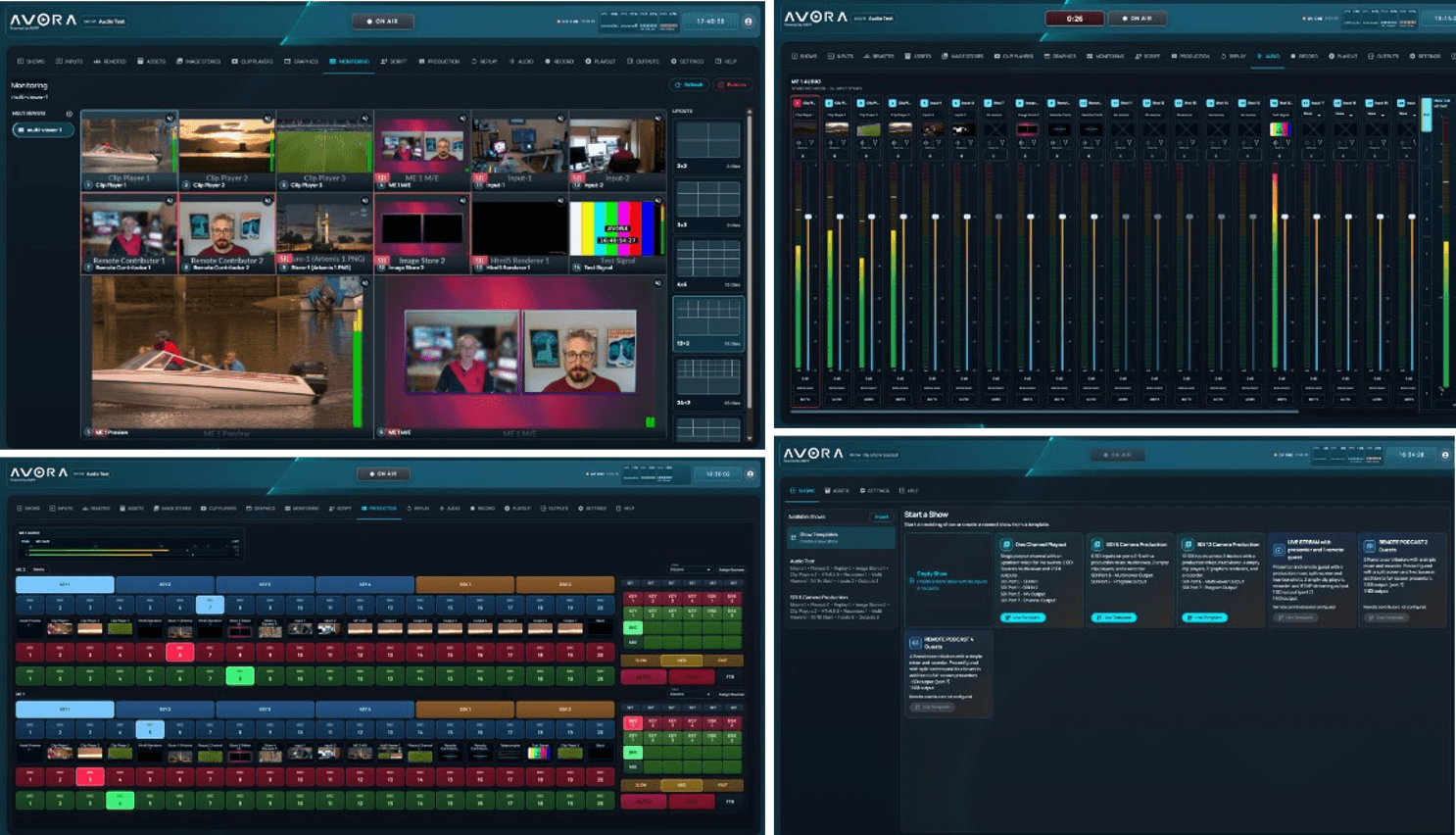
Launched at IBC2026, AVORA gives production teams a complete environment to prepare, produce and deliver live content, from switching and graphics to audio, remote guests, content, replay and delivery.

Tim Burton’s cult classic Beetlejuice has found new life on stage. But recreating its surreal world takes much more than clever costumes and scary set designs