


Lighting Bad Bunny’s tour
A love letter to Puerto Rico wrapped in a stadium-sized extravaganza, here’s how the creative team crafted the lighting for Bad Bunny’s biggest tour to date


What happens when one of Britain’s sharpest lyricists meets real-time rendering and tracking AV tech?
Words Verity Butler
There’s undoubtedly a particular kind of electricity that runs through a crowd when Dave walks on stage. It’s not just that initial starstruck, sharp inhale of breath when he first appears (though there’s plenty of those as well). It’s something more anticipatory.
If you have followed his meteoric rise from Six Paths, through Psychodrama and into We’re All Alone in This Together, you already know Dave doesn’t shy away from putting on quite the show. His past performances have formed a narrative experience beyond the standard usually expected from live music.
Known for his socially conscious lyricism and wordplay, Dave is a British rapper and actor that has seen explosive success throughout his still-early career. From winning the Mercury Prize to album of the year at the BRIT Awards with Psychodrama, his music is praised for its raw but powerful challenge to the British political system and society as a whole. In 2018, his song Question Time, which criticises the British government, won the Ivor Novello Award for best contemporary song.
Even if you aren’t a fan, a quick Google search will turf up one of his most iconic live performances to date: when he played Black – a compelling song that dissects his experience of black identity, excellence and explores what it is like to live in the UK as a black person – at the 2020 BRITs. It totals 12 million views on YouTube at time of writing.
During the viral video, you see Dave use a piano as a narrative tool. He plays it, but he also uses it as a digital canvas on which to cleverly project 3D visuals.
So, when he decided to return for his first UK tour in four years, following the 2025 release of his latest album, The Boy Who Played the Harp, expectations were high. As a fan myself, having spent years watching him evolve into one of Britain’s best live storytellers, the idea of how he would translate his next album, after a fairly long break, into a scalable arena show seemed like both a challenge and an opportunity.
To understand how this particular show came together, you have to start by abandoning the traditional rulebook.
Arena tours tend to rely on a familiar formula: fixed LED walls, cue-based playback and a clear separation between content creation and physical staging. This production, however, which was of course driven by Dave’s own narrative style, needed something more elastic. Ben Annibal, Universal Pixels’ project manager, tells us about it.
“The design was more challenging than usual arena shows that require an upstage screen and I-Mag package,” he explains. “The involvement of tracking screens and real-time content meant we had to look at the overall workflow.”
The phrase ‘overall workflow’ is important. Once you introduce moving LED surfaces into a show (especially eight of them!), everything drastically changes. Content can no longer be pre-rendered to fixed coordinates, and lighting cannot assume static reflections. Even camera shots have to adapt to constantly shifting sightlines. This meant the solution had to involve a system that didn’t just play back content to the crowd, but actively understands the space it’s operating in.
What this led to was a workflow that connected the dots between automation, tracking and rendering. Positional data from the moving screens fed directly into Disguise GX 3 media servers, enabling the system to maintain a continuously updated digital model of the stage. This ‘digital twin’ means every frame of content could be effectively recalculated on the fly, mapped precisely to wherever each screen happened to be in that moment.
Annibal explains the concept in practical terms: “The digital twin aspect of this production was achieved through Disguise software, wherein, a digital model of each LED screen is rendered in the Director in real time, based on the live tracking data supplied to us by the Neg Earth tracking system.
“That allowed rendered content outputs to be accurate for each screen’s position within the 3D world, rather than simply playing back a predetermined content stack.”
The final result is remarkable. As the screens tilt and glide across the stage, the content doesn’t stretch or skew awkwardly – it sticks. Perspective stays correct and depth is preserved, while visual illusions hold together in a captivating manner. Fans are no longer watching video mapped onto screens, but an environment that behaves as though it exists independently.
The resulting depth was achieved through a combination of screen design, content and lighting. The ROE Visual Vanish V8T panels, with their 60% transparency and high brightness, allowed light and imagery to pass through and interact across multiple layers of the system. As the screens moved and lighting states changed, this created shifting levels of opacity and visibility. In addition, two further ROE Visual Vanish V8T screens were used as static I-Mag screens, again fed via Disguise media servers, and all powered by Brompton Technology’s Tessera SX40 LED video processors.
It’s probably unsurprising that pulling off such a feat in a live touring context was not even remotely easy to achieve. Running at 50 frames per second, the system had to process tracking data and render content and output to the screens with minimal latency – all while integrating live camera feeds and generative elements. However, Annibal is quick to point out that this is not about going out and declaring a brand-new universal standard.
“The production design required the servers to process and calculate content in real time to achieve the overall show design. This is not necessarily the future of all shows – more an additional tool in the arsenal to deliver shows in the best way possible to satisfy artistic intent.”
On Dave’s tour, Universal Pixels weren’t just responsible for the media servers or content playback, they also handled the entire video ecosystem, including its infrastructure and integration. This holistic approach proved to be essential in a production where so many different elements needed to work together.
“With multiple layers of technical equipment in the show, there had to be communication on all changes and updates during the design and pre-production process,” says Annibal. “The internal meetings with our technical and production teams were key to keep the flow of information going and make sure delivery stayed on track with the desired outcome.”
Pre-production emerged as an unsung hero of the project. Long before the tour hit rehearsals, extensive testing was carried out in collaboration with Neg Earth, ensuring all aspects of the systems spoke the same language.
“The early-stage pre-production work was a significant factor in making sure everything ran smoothly,” Annibal notes. “We will definitely transfer the knowledge gained from testing and collaborating with others to future projects and tours.”
That collaborative mindset extended across departments. The lighting, video, camera, automation and sound teams all had to align when approaching a project of this magnitude. There was an alternative coping method available. As Annibal puts it with unwavering honesty, ‘mostly with a lot of swear words’.
Putting humour aside, the complexity here is truly substantial. The integration of Panasonic UC4000 cameras, for instance, added another layer of nuance. Shooting in log to retain a wide dynamic range, the cameras fed live imagery into the Disguise servers, where it needed to be colour-matched with both rendered content and LED output. This is while six Blackmagic Micro Studio 4K G2 cameras worked to deliver cutaway shots. The feeds were mixed by Askem on one of Universal Pixels’ Kula PPUs, bringing the live performance into the server system and supplying real-time imagery to both the media servers and screens.
“There is a lot of colour science going on in the background in order to keep everything looking consistent,” James Morden, technical specialist at Universal Pixels, explains.
Then there are the practical realities of touring. Eight moving tracking screens introduce significant complications in terms of power and data distribution. The project used cable runs stretching beyond 150m in some cases, raising concerns around voltage drop and system sustainability.
“Cable management over longer-than-normal distances was the largest technical challenge,” admits Annibal. “Fortunately, in collaboration with our long-term distro supplier, StageSmarts, we were able to deliver power to the screens in a safe manner, without having to disable any of the safety features we normally would expect to.”
It is a strong reminder that, for all the talk of rendering and digital twins, live production still lives and dies by its fundamentals.
“The Dave tour has not necessarily taught us anything specifically new.” Annibal reflects, “It has highlighted and reminded us, however, of the benefits of communication that goes beyond our sand-box, so when someone plugs a network cable into the wrong socket, the whole show doesn’t stop.”
By the time the tour reached its final show dates, the system had evolved into something finely tuned yet still flexible, a platform that could adapt and, with each subsequent show, push closer to the creative ideal.
“It’s about that continual push to get it as close to perfect as possible,” Annibal concludes. And that ethos is the clearest takeaway from this production.
This article was first published in the Summer 2026 issue of LIVE.
A love letter to Puerto Rico wrapped in a stadium-sized extravaganza, here’s how the creative team crafted the lighting for Bad Bunny’s biggest tour to date
dBS Solutions provided sound reinforcement for the dance-focused Daresbury Festival at Walton Hall and Gardens in Warrington, Cheshire, with all three stages powered by Martin Audio systems.
When your venue has welcomed everyone from Miles Davis to Amy Winehouse, standing still isn’t an option. The most recent Ronnie Scott’s redevelopment proves even an icon can evolve
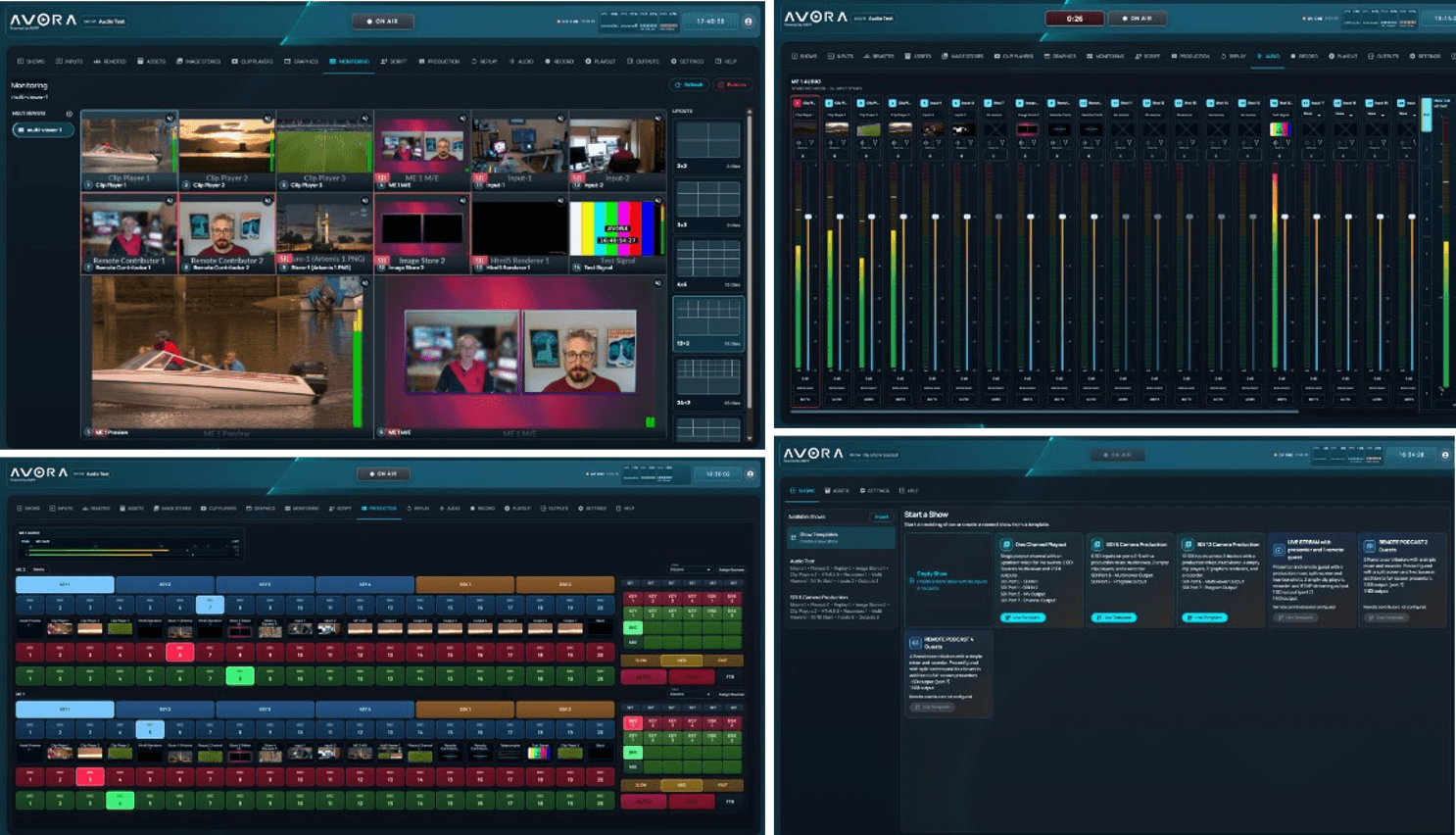
Launched at IBC2026, AVORA gives production teams a complete environment to prepare, produce and deliver live content, from switching and graphics to audio, remote guests, content, replay and delivery.

Tim Burton’s cult classic Beetlejuice has found new life on stage. But recreating its surreal world takes much more than clever costumes and scary set designs